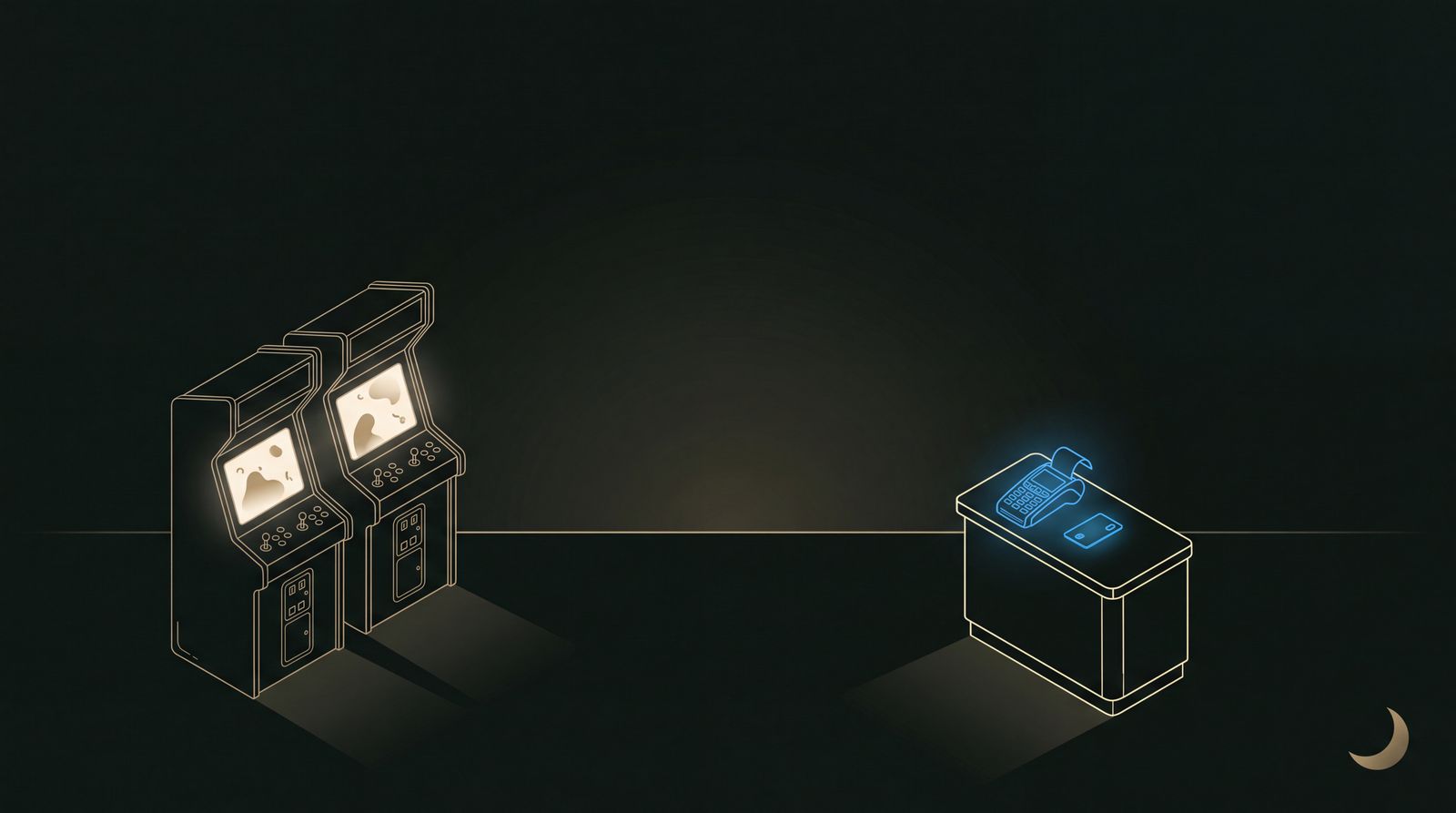
The misunderstanding: paying at the machine
Ask around in the sector about cashless payments and you quickly hear the image of a guest tapping a card against the slot machine and playing straight away. That image does not match Dutch rules, and it is more than a technicality.
Dutch gambling regulation does not allow a direct card payment on the slot machine itself. Money goes in as cash, or through a system that tracks play credit and partly replaces the machine's coin-in and pay-out mechanism. That second route is cashless play, and it comes with conditions.
The misunderstanding costs operators time. They ask their bank or provider for something that cannot work in that form, get turned down, and conclude that card payments in an arcade are impossible. They are not. They simply belong somewhere else in your venue than people assume.
The misunderstanding costs operators time: they ask for something that is not permitted, get turned down, and conclude that card payments in an arcade are impossible.
Cashless play works, but only with an exemption
Cashless play exists in Dutch gaming arcades and is already running at a growing number of operators. The exemption is the key.
Cashless play requires an exemption from the Kansspelautoriteit. It is granted per venue and is valid for a number of years. Without it your venue cannot run cashless, however well your technology is set up.
Under that exemption, a central payment system tracks your guest's play credit, for example on a chip card or an account. The machine reads that credit instead of accepting coins or notes.
The exemption and the cashless system sit with you as the operator and with your system supplier. They are separate from your payment solution: the play system on one side, the card processing on the other.
Where the card payment does happen
If payment does not happen at the machine, where does it happen? At the places your guest already visits.
- At the counter. A fixed terminal where your guest pays, just like in any other business. Contactless, chip and phone payments come as standard.
- At the change desk. The place where cash and play credit change hands is also the logical place for the card payment.
- At the top-up point. If your venue runs cashless, this is where your guest loads play credit. The card payment involved is an ordinary card transaction that connects to your cashless play system.
In all three cases this is a card payment like any other: the terminal processes the transaction, and the payment solution makes sure the money reaches the venue's account. What sets your venue apart is not the technology of the payment, but the question of which party is willing to accept that transaction.
Why banks and providers hold back
A gaming arcade is a fully regulated business, with an operating permit and a completed Bibob integrity screening. Yet applications regularly stall, and that has little to do with your company.
The classification gets in the way. Every business is assigned a Merchant Category Code, and for gambling that is code 7995. Once that code is attached to your business, banks, providers and card issuers place you in the risk category, no matter how well your venue is run.
Card issuers decline transactions on that code more often than average, and the sector's historical image of chargebacks does the rest. The result is an application that stalls, or a provider that pulls out over time.
Cost perception adds to it: going cashless and taking card payments have a reputation for being expensive. In a market under pressure from higher gambling tax and falling visitor numbers, that is a reason not to bother. Yet a transparent pricing model is exactly what shows you where your money goes.
What you need to arrange it properly
Card payments in your venue rest on three things, and they can be arranged independently.
- Your permit and, if you run cashless, your exemption. These sit with you and the Kansspelautoriteit. A payment provider does not arrange this for you.
- Your cashless play system, if you use one. This comes from your system supplier and tracks the play credit.
- The payment and acceptance layer. The terminals, the card processing and the registration under the right category code. This is the part where most venues get stuck, and where a provider that knows the sector makes the difference.
At LunaPay, that last part is ours. We connect to the till, the equipment and the cashless system you already have, and arrange the card processing around them. LunaPay works with multiple licensed European acquirers: if one drops out or tightens its policy, we move you to another.
What your venue needs depends on your setup, your volume and whether you run cashless play. We calculate that clearly for you up front, so you know where you stand before anything gets installed.